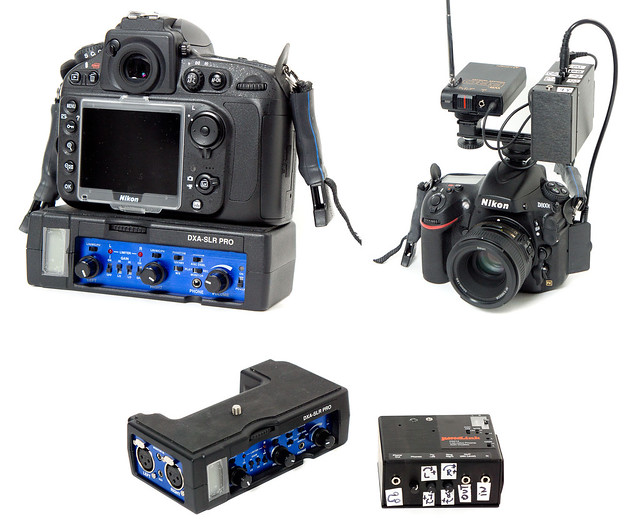
I was very curious to find out if we still need to bother with low noise pre-amps when shooting with the latest Dslr’s from Nikon and Canon. The Canon 5D3, Nikon D800/D800E and the Nikon D4 offer manual gain control and a headphone jack to monitor sound. The built in amplifiers have been improved, however, once we turn up the levels it gets noisy (tested on the D800E, will update this post once I get the chance to try it on the 5D3). BH was kind enough to send over the Beachtek DXA SLR Pro, an incredibly solid unit, I love the form factor and the recessed control switches. Video and sound samples after the break
The high quality XLR inputs allow us to connect professional microphones, 12 or 48V phantom power can be sent to each channel for powering condenser microphones, each channel features a switchable 15dB gain switch, we still get the AGC Disable feature in case we want to use cameras with auto gain control only. The meter levels are in the right place and display in 3dB increments. The headphone output enables the monitoring from the adapter during recording, still essential for cameras without a headphone jack. Of course on cameras with a headphone jack we want to plug our headphones directly into the camera.
Use headphones when listening to the comparison between the beachtek feed and direct feed.
After this short test it is pretty obvious we still need low noise, low distortion, wide-frequency response preamps to ensure superb audio quality.


The Good on the Beachtek DXA SLR Pro:
Solid built, great control layout, battery grip form factor
XLR input, phantom power
15DB low noise, low distortion pre-amp
The Not So Good
heavy
battery grip form factor might not be for everyone
gets awkward if you try to attach it any other way


If you don’t need XLR inputs, check out the Juicedlink DS214, I love this thing for small foot print/wireless lavelier set ups. It is about half the size of the DXA SLR pro, a high quality low-noise preamplifier with a 3.5mm stereo minijack input, high/low gain settings, and individual control for each channel. Maximum gain is 30db, this little box produces a very clean, low noise low distortion signal and greatly enhances the sound quality.
The Good: Juicedlink DS214
small and lightweight unit, many ways to attach to the camera/rig
without getting in the way,
excellent, high quality low noise/distortion free pre amp, all the way up to 30db
solid metal case and high quality plugs
The Not So Good:
diode level indicators instead of LCD (certainly not a deal breaker)
headphone volume, channel controls, signal in/out lack clear markings, work around: label each
in/out put, volume, and channel control yourself.
Additional equipment:
Azden WR Pro wireless lavelier kit
Nikon D800E
Nikkor 50mm 1.8G
still shots and video shot with
Sony Nex 7 and the kit lens

If you find this article inspiring, please consider helping me maintaining this blog by purchasing your gear through my product links to Adorama and B&H. It will cost you nothing and allows me to keep adding! Or consider making a direct donation using PayPal, thank you!
Hi Ciaran, haven’t done any tests with phantom power, I would guess with a fresh 9V you would get about 6 to 10hours of run time, a very conservative estimate
Hi Mike,
I was wondering if you got a chance to test the battery life much on the beachtek? I’m pretty much sold on one, but I regularly use a rode ntg3 which runs on 48v phantom. I couldn’t find much mentioned on this anywhere and wondered if you had had a chance to experiment with the power consumption with phantom on?
Thanks
Ciaran
A handy bit of kit… HD sound to match the HD video. I would be delighted if you would add your photography resource to Geotog.com R
egards Tony at Geotog